
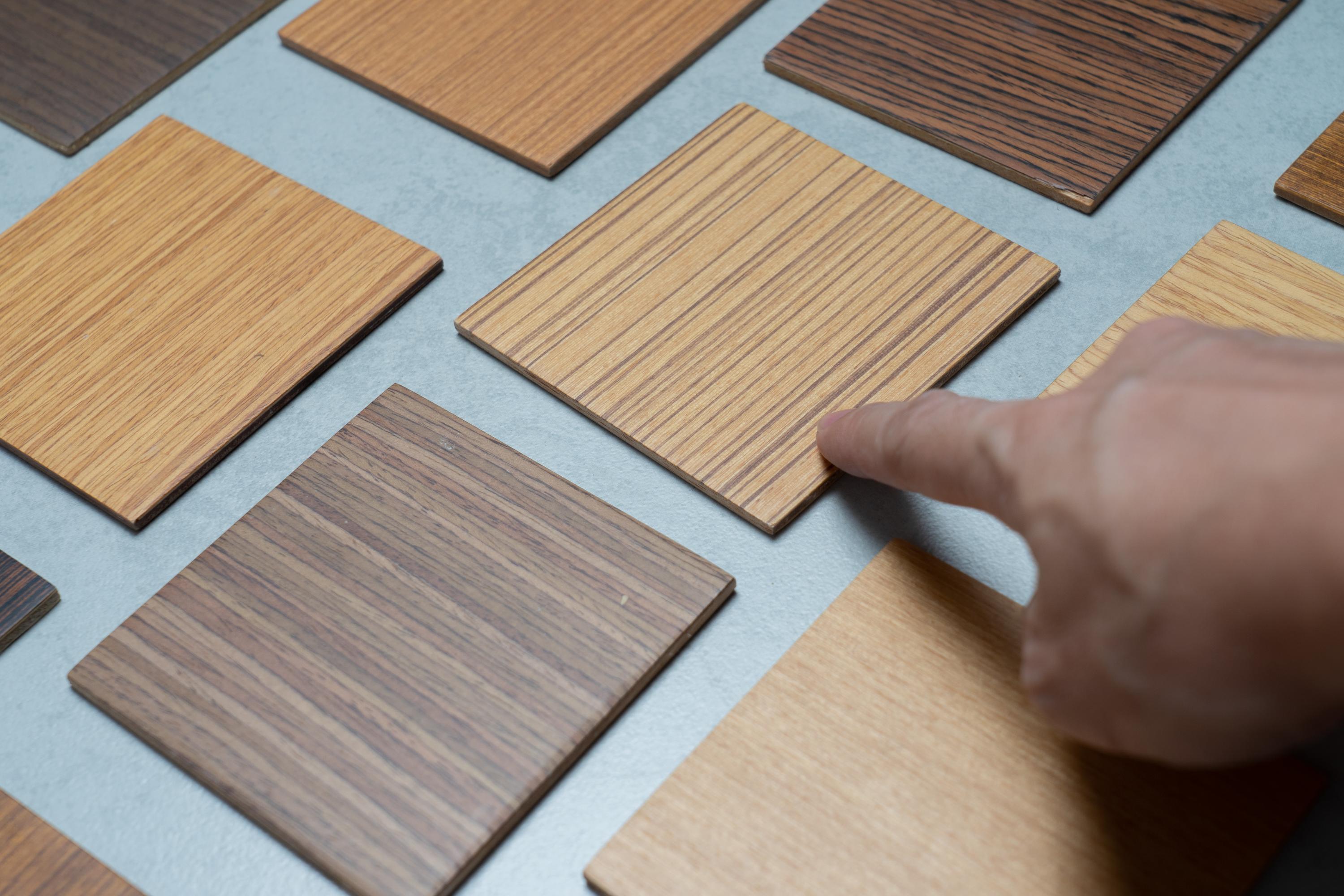

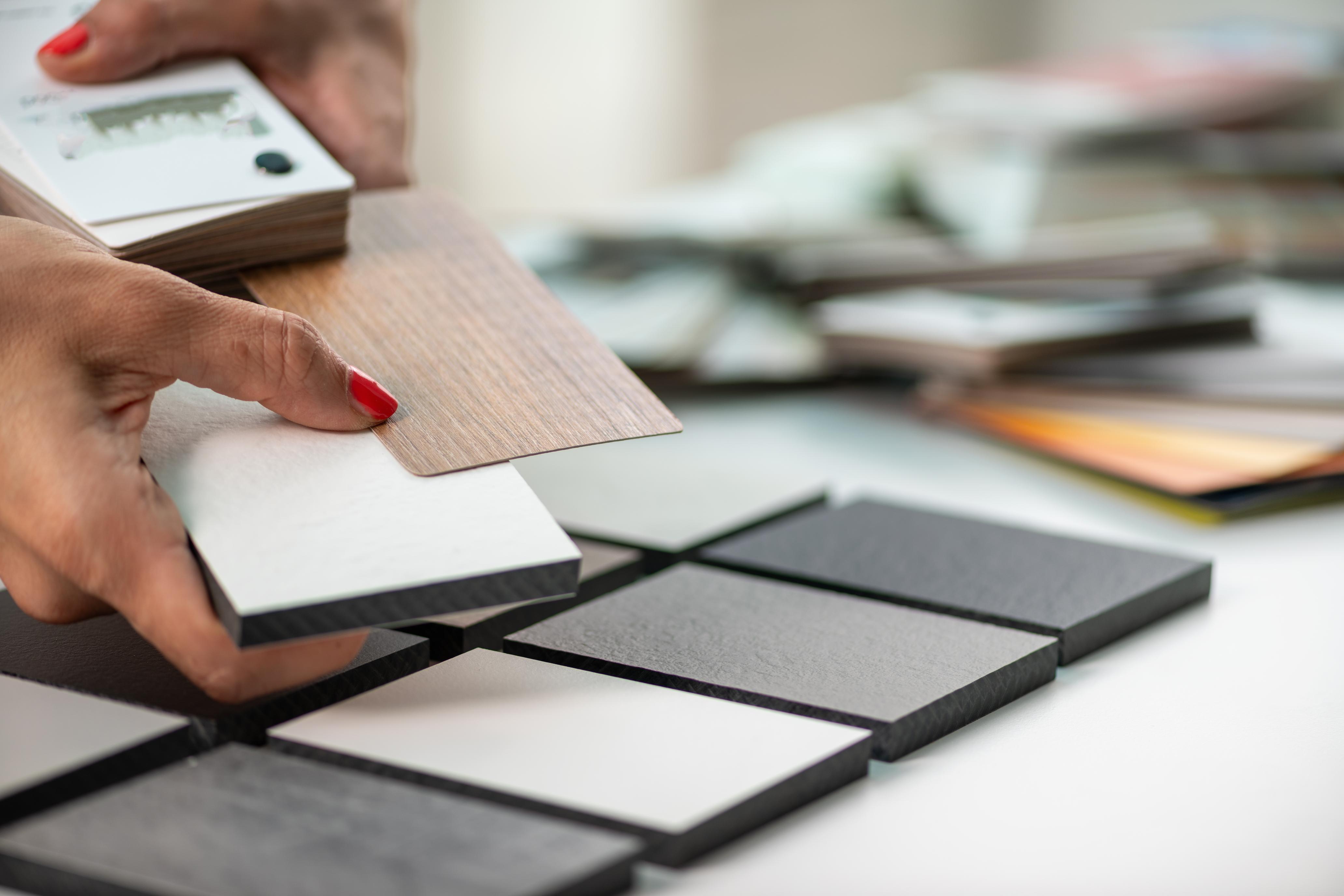


Grid Collection · 46 designs matched
1 · mm
PVC · 23 & 45 mm widths
— The Idea
For years, the edge has been the
compromise.
Every laminated panel in a kitchen, a wardrobe, an office cabin ends the same way. A carefully selected surface — grain, texture, colour — meets an edge dressed in something else. A plain matte strip. A close-but-not-exact match. A visible line that reminds you the surface was made in a factory and then trimmed to fit.
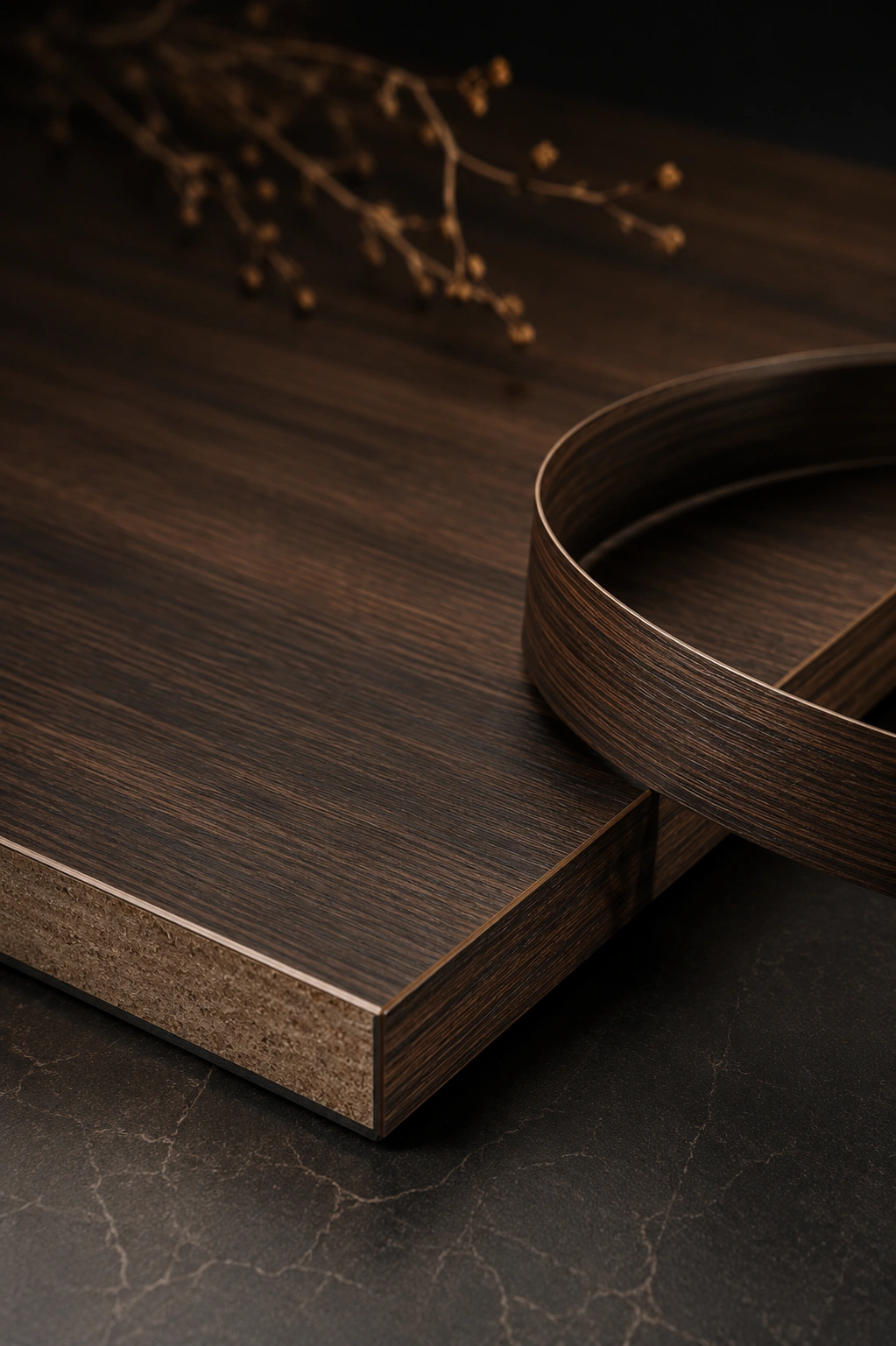
Continuum was drawn to end that compromise. Every edgeband in the range is printed and embossed from the same origin file as the laminate itself. The grain runs on. The texture continues. The line between surface and edge, for the first time, is not a line at all.
It is a product built on a simple discipline: what you specify at 8 × 4 feet, you receive at 23 millimetres. Nothing is approximated.
1 mm · The exact width of the difference
— Design-Matched
Same file. Same press. Same finish.
A matched pair is not a colour approximation. It is the same design, produced in two widths.
The industry standard treats edgebanding as a consumable — a plain PVC ribbon in a roughly compatible shade, applied after the fact and hoped for the best. It works, at a distance. Under a spotlight, at eye level, on a handleless drawer front, it does not.
Every Continuum edgeband is drawn from the same original artwork as the Wonderlam laminate it is paired with. The same decor, the same grain direction, the same surface embossing. Applied to the edge of an HPL panel, the two read as one continuous piece of material.
For the architect specifying a shadow-gap kitchen, for the fabricator building a wall of matched wardrobes, this is the difference between a joint you notice and a joint you don't.
Grid Collection · HPL sheet · 8 × 4 ft
Continuum · edgeband · 23 or 45 mm
— The 1 mm Difference
Thicker by a quarter. That quarter shows.
On a spec sheet, the difference between 0.8 and 1.0 is a rounding error. On a drawer edge that opens ten times a day for ten years, it is the reason the finish is still there.
Continuum 1.0 mm
Deeper edge break. Withstands radiusing, sanding, and the years of a busy kitchen.
Industry Standard 0.8 mm
Cost-optimised for volume. Enough substrate for a router pass. Rarely enough for a second one.
— The Range
Every design in the Grid Collection. Every one matched.
Continuum is launched exclusively for the Wonderlam Grid Collection. Forty-six laminate designs — from architectural woodgrains to textile weaves to raw stone surfaces — each with its edgeband cut from the same artwork. Not a subset. Not a curated few. The complete range.
— The Grid Collection remains the sole home of matched edgebanding at Wonderlam.
— Specification
The technical read.
Precise material data for engineers, fabricators, and specification writers.
| Specification | Detail |
|---|---|
| Material |
High-quality PVC Selected for consistent colour reproduction, texture retention, and adhesive receptivity under standard EVA and PUR hot-melt systems. |
| Thickness | 1.0 mm Compared to the industry-standard 0.8 mm. Allows radius profiling, sanding, and long-term wear resistance. |
| Widths | 23 mm · 45 mm Sized for standard 18 mm and 25 mm engineered board substrates, with cover margin for trimming. |
| Roll length | 50 m Supplied on standard cores, wound for automated and manual edgebanders alike. |
| Edge profile | Straight Post-forming and radius profiles are not currently offered. |
| Adhesive | Supplied without pre-applied glue For fabricators using their own hot-melt system — EVA, PUR, or comparable — to specification. |
| Design matching | Exact — sourced from the parent HPL artwork Every SKU shares its decor code with the corresponding Grid Collection laminate sheet. |
| Compatible range | Grid Collection · 46 designs Continuum is not currently offered for Solique, Phoenix Ten-X, or other Wonderlam laminate ranges. |
| Application | Interior furniture, cabinetry, shopfitting Kitchen shutters, wardrobe fronts, office and hospitality millwork, retail casework. |
— Built For
Where the edge matters most.
Handleless kitchens
Where the drawer edge is the handle, and the eye reads the joint every time it's opened. The line where surface meets edge is a design surface in its own right.
Wardrobe walls
Full-height, floor-to-ceiling shutters where a mismatched edge repeats itself across ten metres of frontage. Match the pattern once, and it multiplies quietly.
Millwork and retail
Reception desks, retail casework, hospitality millwork under downlights. Where the client will run a hand over the edge on the way past.